The Casebook of Nips & Porkington (2015) from Melody Wang on Vimeo.
The Casebook of Nips & Porkington, a hand-drawn animation with a print media background. The filmmaker inserts a balanced graphics and visual tricks which become part of the narrative and overall style.
Tuesday, 20 October 2015

Friday, 16 October 2015
Chris Watson at Lighthouse Arts venue Brighton
** A great opportunity **
Chris Watson 'The Sound of Story' - an exploration of sound and music in story telling. Talk and workshop, 17 & 18 November 2015.
Wildlife sound recordist and composer Chris Watson is a speaker and workshop leader at The Sound of Story 2015: two days of talks, screenings and workshops that explore the creative potential of sound in the storytelling process.
Further details here: Lighthouse

Chris Watson 'The Sound of Story' - an exploration of sound and music in story telling. Talk and workshop, 17 & 18 November 2015.
Wildlife sound recordist and composer Chris Watson is a speaker and workshop leader at The Sound of Story 2015: two days of talks, screenings and workshops that explore the creative potential of sound in the storytelling process.
Further details here: Lighthouse

Wednesday, 7 October 2015
"I don't want my image to appear in the mass media," he says, in a gentle voice still inflected with German, "since it would detract from the project." Between 1977 and 1980, Metzger went on an art strike, refusing to labour for the exploitative Man. - Gustav Metzger, The Guardian Website - 2012.
Metzger's Auto-Destructive art can be seen to be art in its truest form, since it is free from venture capitalists appropriating it for profit and gain. Surely art in its self can be true to its self and not merely be a commodity. Metzger's work creates a cyclic theme of destroying whilst creating, meaning that it cannot be bought, sold and traded, it can only be observed.
The piece below was in response to Nuclear arms development. Since then the piece has been recommissioned at the Tate in 2004.
acid on nylon canvas 1961

Metzger's Auto-Destructive art can be seen to be art in its truest form, since it is free from venture capitalists appropriating it for profit and gain. Surely art in its self can be true to its self and not merely be a commodity. Metzger's work creates a cyclic theme of destroying whilst creating, meaning that it cannot be bought, sold and traded, it can only be observed.
The piece below was in response to Nuclear arms development. Since then the piece has been recommissioned at the Tate in 2004.
acid on nylon canvas 1961

Monday, 5 October 2015
Airan Kang
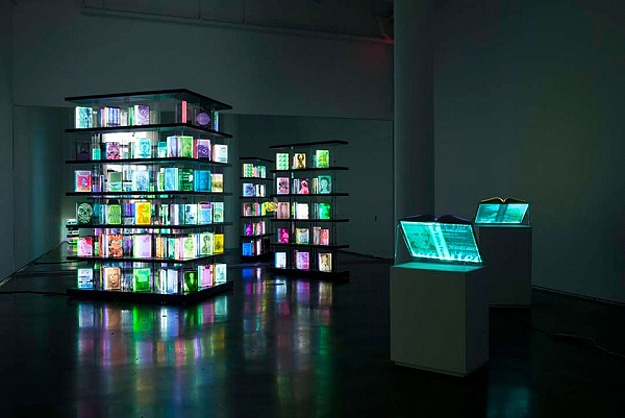
Something that has really stood out to me is the work of Airan Kang. Particularly the piece where she created a futuristic digital library. She re-created all of the books in it and used LED lights and other electronics. In order for her to emphasise the idea of 'never judging a book by its cover', she filled the books not with the original words, but with small tributes inside. Overall, I found this piece of work extremely visually appealing and feel as though the idea of books becoming more and more digital is something that I would like to look more into, in regards to my project.

Inspiration - Federica Babina
The Evolution of Daily Objects in a Century
Federica Babina an architect and illustrator, made a life style project of posters showing the evolution of everyday objects. This is a good example about how objects are continuously changing throughout time, especially technology. This also makes me wonder how other daily objects (keys, chairs, paper clips) have changed and how you would be able to present these difference. I like Babina's work because it highlights the potential for digital technologies to take over our everyday lives by replacing the functionality of old objects and integrating them into a softwares for smartphones and computers.


http://www.fubiz.net/2015/09/30/the-evolution-of-daily-objects-in-a-century/
The Woolworths Choir of 1979 - Elizabeth Price
The Woolworths Choir of 1979 by Elizabeth Price is a Video installation, which featured in the Turner in 2012. Price won the Turner Prize that year - awarded for excellence in Art and with prize money of £20000. More details here:
The Turner Prize on Wikipedia
I saw this installation and was mesmerised by its simplicity and power. The narrative that Price creates combines historical imagery from Gothic church choir stalls with footage from 1970's TV and a news feature about a deadly fire that occurred in a Manchester branch of Woolworths.
I find the work inspirational because Price broke the mould of what 'video art' could be both as medium and concept. This is because the work ingeniously incorporates elements of historic culture/ anthropology, graphic design, popular culture (TV) and aspects of journalism and weaves them together with a haunting soundtrack to tell a story that is filled with mystery and tension.
In subsequent interviews with the artist it is no coincidence that Prince defines her art as that which has the history of culture and media as well as their means of production at her disposal; From historic archived material for content to photography or graphic design and montage effects as a means for making - an acknowledgement that the terms of reference for what is possible and how we perceive and make visual art has changed dramatically with the advent of digital technology.
Further Info - Interview with Elizabeth Price (4.08 min)
I saw this installation and was mesmerised by its simplicity and power. The narrative that Price creates combines historical imagery from Gothic church choir stalls with footage from 1970's TV and a news feature about a deadly fire that occurred in a Manchester branch of Woolworths.
I find the work inspirational because Price broke the mould of what 'video art' could be both as medium and concept. This is because the work ingeniously incorporates elements of historic culture/ anthropology, graphic design, popular culture (TV) and aspects of journalism and weaves them together with a haunting soundtrack to tell a story that is filled with mystery and tension.
In subsequent interviews with the artist it is no coincidence that Prince defines her art as that which has the history of culture and media as well as their means of production at her disposal; From historic archived material for content to photography or graphic design and montage effects as a means for making - an acknowledgement that the terms of reference for what is possible and how we perceive and make visual art has changed dramatically with the advent of digital technology.
Further Info - Interview with Elizabeth Price (4.08 min)
Sunday, 4 October 2015
Infinity Room Installation
http://www.fubiz.net/en/2015/09/23/the-infinity-room-installation/

I found this immersive light installation project particularly interesting; the interactivity is something that I would love to re-create.
The room is supposed to 'transforms at his contact and becomes an artificial, engrossing environment that changes his presence’s perception in an illusory and non-physical world' - the way in which the project removes the viewer from a gallery experience and allows them to be fully involved with the actions and outcomes of the light in reaction to movement, is inspiring.

I found this immersive light installation project particularly interesting; the interactivity is something that I would love to re-create.
The room is supposed to 'transforms at his contact and becomes an artificial, engrossing environment that changes his presence’s perception in an illusory and non-physical world' - the way in which the project removes the viewer from a gallery experience and allows them to be fully involved with the actions and outcomes of the light in reaction to movement, is inspiring.
Wednesday, 30 September 2015
Something Inspirational - Charleston House
Although this isn't exactly related to Digital Media, I went to see Charleston House in Lewes and found it inspirational.


The artists who lived there would turn every single domestic item into things of beauty. They believed that whenever your eyes rest, they should rest on something beautiful. Even when they installed central heating and put radiators into the house they would cover it up and turn it into a masterpiece because the artists felt the radiator was unsightly.
This could help inspire my project idea as I am interested in branding and the concept of Google's material design theory. I am thinking of critiquing the material design language, and Charleston House artwork has given me a possible idea that I could reverse the theory, and somehow feature digital design work featured on material.
Subscribe to:
Posts (Atom)